
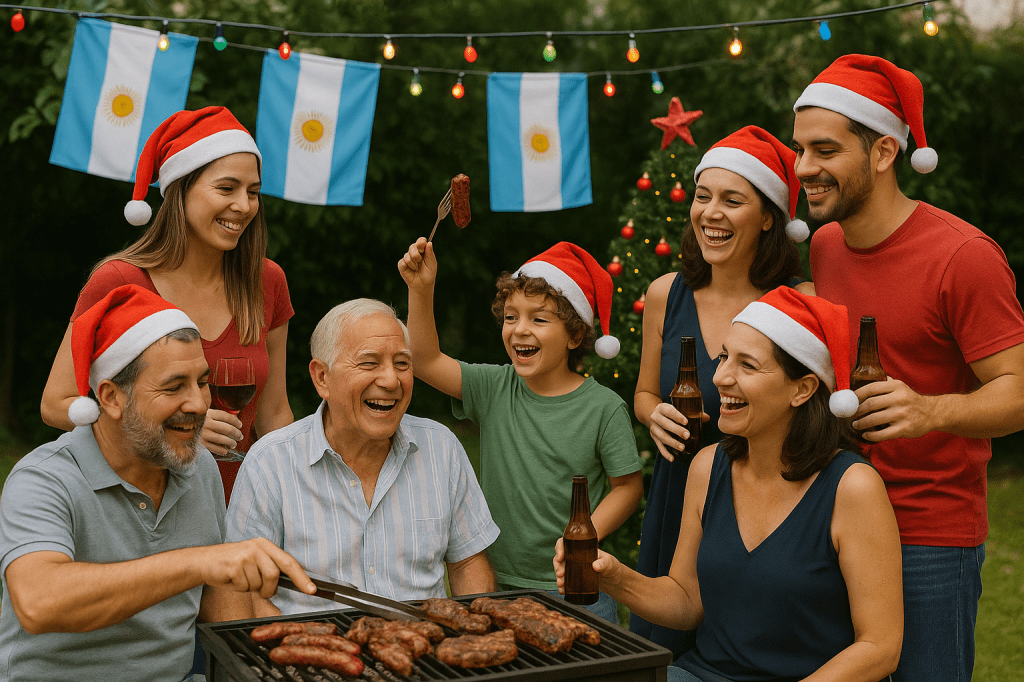
If you’re coming to Argentina around December, get ready — Christmas here is unlike anything you’ve experienced in the U.S. or Europe. Forget snow, sweaters, and quiet family dinners. In Argentina, Christmas feels more like New Year’s Eve: it’s loud, warm, full of people, and it goes on all night.
In this post, I’ll walk you through what a typical Christmas Eve (Nochebuena) celebration looks like, how Argentinians celebrate it, and why you’ll definitely want to learn some Spanish if you plan to be here for the holidays.
First Things First: What Do We Call It?
In Argentina, we call Christmas “Navidad”. You’ll hear it pronounced Nah-vee-DAHD or sometimes jokingly shortened in speech as “la Navi” or similar playful versions — but the actual word is Navidad.
Family Comes First — And in Large Numbers
Argentinians love big family gatherings. It’s very common for the entire extended family to celebrate together — cousins, uncles, distant relatives, family friends, everyone. The celebration usually takes place at the home of a grandparent or the most respected family member.
So don’t be surprised if you find yourself surrounded by 30, 40, or even 50 people. It can feel overwhelming at first, but that’s part of the charm. It’s loud, loving, chaotic, and full of energy.
The Schedule: Late and Long
Here’s the basic timeline of a traditional Christmas Eve in Argentina:
- 8:00–9:00 p.m.: Close family members arrive early to help set up, prepare food, and get everything ready.
- 9:30–10:30 p.m.: The rest of the family and friends start to arrive.
- 10:30 p.m. onwards: Dinner is served, and the party begins.
- 11:30 p.m.: The «mesa dulce» (sweet table) comes out.
- 12:00 a.m.: Fireworks! 🎆 This is the big moment — like the countdown to New Year’s. Everyone cheers, hugs, and opens gifts.
And the most important detail? The party continues all night. People stay up talking, dancing, and eating until 5, 6, or even 8 in the morning.
The Food: Not What You Might Expect
Depending on the family, Christmas dinner can be hot or cold, but during Argentina’s summer heat, cold meals are popular.
Some typical Christmas dishes include:
- Vitel toné (veal with tuna sauce)
- Russian salad (potatoes, peas, carrots, mayo)
- Sandwiches de miga (crustless thin sandwiches)
- Empanadas
- Asado (barbecue) – in many families
At around 11:30 p.m., we bring out the mesa dulce, a table full of sweets like:
- Pan dulce (our version of panettone)
- Turrón (nougat)
- Garrapiñadas (sugar-coated peanuts)
- Chocolate
- Almonds and nuts
Gifts and Fireworks
Santa Claus (called Papá Noel) doesn’t always hand out gifts personally in Argentina. Often, the presents are left under the tree and opened at midnight — no waiting until the 25th in the morning like in the U.S.
At midnight, the sky lights up with fireworks from every direction. It’s noisy, colorful, and full of energy — the exact moment when Christmas really begins.
The Afterparty
Once the fireworks settle, the real party begins. Expect music, dancing, drinks, and even more food. Young people often head out to dance with friends or visit neighbors, while families continue to celebrate at home.
The party lasts all night — literally. It’s not uncommon to go to bed at 6 or 7 a.m. the next day… if you go to bed at all.
Why You Need Spanish at Christmas in Argentina
If you’re invited to spend Christmas with an Argentine family, you’ll want to do more than just sit quietly in a chair. You’ll want to talk to people, connect with your partner’s family, understand jokes, and be part of the celebration.
That’s why learning Spanish before arriving is key.
How I Can Help You Speak Argentinian Spanish
If you’re serious about traveling, moving to Argentina, or just finally learning the language that you’ve always wanted to speak — I’m here to help.
I’m Nicolas Gonzalez Miño, Argentine Spanish teacher, owner of the YouTube Channel “Spanish with Nico”, the founder of Spanish Mindset Academy – Learn Argentinian Spanish and the author of Mini Stories to Learn Spanish for Beginners, available on Amazon. Also, I have 2 podcast Argento Podcast, & Argentine Spanish from Scratch where I teach real Argentinian Spanish and slang.
In my YouTube Channel “Spanish with Nico”, with +1500 subscribers, I teach Spanish language and our dialect -Argentinian Spanish- and I explain everything about Argentinian history and culture.
In my individual programs (private 1:1 online classes), you can learn Argentine Spanish from scratch, for traveling, living, or doing business, and finally ACHIEVE FLUENCY in Argentine Spanish. Start learning Argentinian Spanish with me right now and be free in ARGENTINA!
👉 Ready to start?
Check the links below to join my 1:1 program to learn Argentinian Spanish in private lessons or contact me directly on here.
Click here for more details for: 1:1 PROGRAM.
Click here for more details for: 1:1 PROGRAM.
Click here for more details for: 1:1 PROGRAM.
📌 Ready to Learn More?
👉 Argentine Spanish 1:1 Programs: https://spanish-mindset.com/solo-lessons/
📘 Argentine Spanish Full guide: Argentine Spanish: The Definitive Beginner’s Guide (1 hr )
💬 Join my Community: ARGENTINA | Spanish with Nico
📩 My YouTube Channel, Spanish with Nico.
Final Thoughts
Christmas in Argentina is a wild, beautiful, emotional, chaotic experience — and you’ll love it, especially if you’re ready to join in the fun.
So don’t be shy. Learn some Spanish, bring your best energy, and enjoy the fireworks, food, and fiesta like a true local.
See you in Argentina. ¡Feliz Navidad! 🎄



 Learn Argentinian Spanish: Slang & Culture | Spanish Mindset