
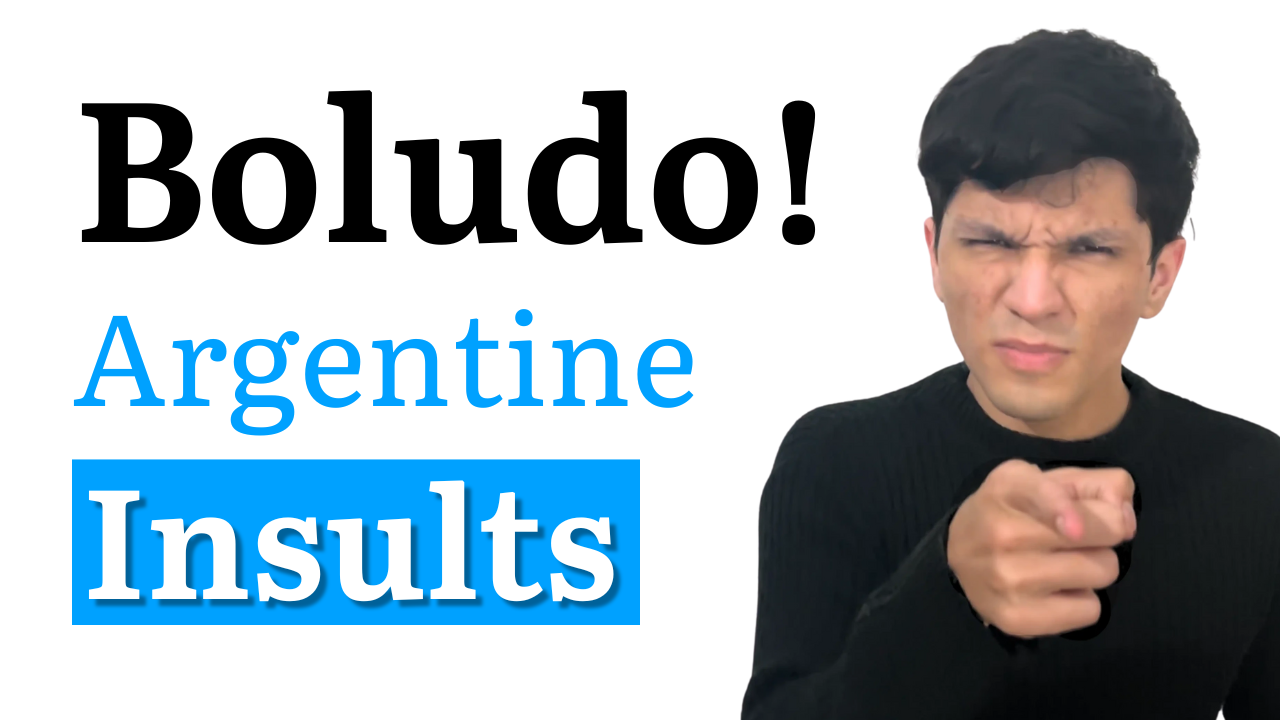
Why people think Argentines “insult all the time”
Visitors often notice that in Argentina people throw around “insults” with friends, family—sometimes even with strangers. The key is context. Many words that look harsh on paper are used affectionately or playfully in everyday speech. Others are truly offensive and can start a fight. This guide helps you tell the difference in Argentine Spanish.
Rule #1: Context is everything
This is the first KEY RULE FOR ARGENTININIAN SPANISH INSULTS
- Tone + relationship: The same word can be a joke with friends and an insult with a stranger. You must at least understand the context you are at, and whether or not you know the person you are talking with.
- Who says it first: Locals can “insult” each other and laugh; you, as a foreigner, should be careful. Later, with time, this will not be a problem anymore and you will always say it right.
- Public vs private: What flies at a barbecue with friends might not fly in public spaces.

Friendly(ish) “insults” you’ll hear everywhere
1) boludo / boluda
Literal idea: “dummy / silly” – but in Argentina it often just means “dude / mate.”
- Common, friendly use:
- “¿Qué hacés, boludo?” — “What’s up, dude?”
- “Dale, boluda, vení.” — “C’mon, girl, come here.”
Examples (with translation):
- “¡Boludo, te olvidaste las llaves!” — “Dude, you forgot your keys!”
- “Che, boluda, ¿vamos al cine?” — “Hey, girl, shall we go to the movies?”
Tip: As a foreigner, it’s safer to recognize boludo than to use it first.

2) pelotudo / pelotuda
Meaning: Harsher than boludo. Can be used jokingly among close friends, but it’s riskier.
- Playful among very close friends:
- “Dale, pelotudo, apurate.” — “Come on, idiot, hurry up.”
- Insulting with strangers: Don’t use it.
Examples:
- Friendly (between close friends only): “Sos un pelotudo… ¡mirá lo que hiciste!” — “You idiot… look what you did!”
- Offensive (avoid): “¿Qué mirás, pelotudo?” — “What are you looking at, idiot?”
Exclamations when something goes wrong (not aimed at a person)
These are like saying “damn” or stronger in English. They’re reactions, not labels for a person.
- “¡La puta madre!” — Strong “damn it!”
- “¡La puta madre, se me cayó el vaso!” — “Damn it, I dropped the glass!”
- “¡La re puta madre!” — Even stronger version. Avoid in polite settings.
- “¡La concha de la lora!” — Very Argentine, vulgar, used as a frustrated outburst.
- “¡Mierda!” / “¡La mierda!” — “Damn / shit!” (generic exclamation)
Use sparingly in public; these are vulgar, but not directed at a person.
The nuclear option: “la concha de tu madre”
This is highly offensive when aimed at someone. It can start a fight.
- Only locals might use it jokingly among tight friends who 100% understand the tone.
- As a visitor, do not direct this at anyone.
Offensive example (avoid):
- “¡La concha de tu madre!” (at someone) — Extremely insulting.
Nicknames that sound rude but can be affectionate
Argentines also use descriptive nicknames that may look rude in other cultures but are often friendly here. Still, use with caution—listen first.
- Gordo / Gorda — “Chubby” (affectionate nickname for partner/friend)
- Flaco / Flaca — “Skinny / slim” (very common, friendly)
- Ruso / Rusa, Polaco / Polaca — Often used for very fair/blonde people
- Tano / Tana — For people with Italian heritage/looks
- Turco / Turca — Historically used for Middle-Eastern heritage/looks
Examples:
- “¡Flaco, vení un segundo!” — “Hey, skinny, come here a second!”
- “¿Todo bien, Gorda?” — “All good, babe?” (between partners)
If you’re not sure, don’t use these nicknames. Let locals use them first.
Quick intensity scale (tourist cheat sheet)
| Expression | Typical Use | Intensity* | Safer for visitors? |
| boludo/boluda | “dude,” playful scolding | 2/5 | Recognize ✅ / Use carefully |
| pelotudo/pelotuda | harsh “idiot” | 3–4/5 | ❌ Avoid using |
| ¡La puta madre! | frustrated outburst | 3/5 | ⚠️ Use sparingly |
| ¡La re puta madre! | stronger outburst | 4/5 | ❌ Avoid |
| ¡La concha de la lora! | very vulgar outburst | 4/5 | ❌ Avoid |
| “la concha de tu madre” | direct insult to someone | 5/5 | 🚫 Never use |
*Intensity varies by tone, place, and relationship.
Safer everyday alternatives (sound local without swearing)
- “Uy, qué macana!” — “Oh, what a bummer!”
- “Qué bajón.” — “That sucks.”
- “Che, pará.” — “Hey, stop / wait.”
- “No seas tonto/a.” — “Don’t be silly.”
- “Dale, che.” — “Come on, man.”
Mini-dialogues (Spanish + English)
1) Playful scolding (friends):
— “¡Boludo, tiraste el agua!”
— “Dude, you spilled the water!”
2) Frustration (not at a person):
— “¡La puta madre, perdí la SUBE!”
— “Damn it, I lost my transit card!”
3) Risky with strangers (don’t do this):
— “¿Qué mirás, pelotudo?”
— “What are you looking at, idiot?” (Very offensive.)
When NOT to use any of this
- With people you just met (unless they start and it’s clearly playful).
- With service workers, police, or in official settings.
- In mixed groups where you don’t fully understand the vibe.
- When someone already looks tense—choose polite Spanish.
Key takeaways
- Many Argentine “insults” are social glue among friends.
- Context, tone, and relationship matter more than the dictionary meaning.
- As a foreigner, it’s smartest to understand first, use later (or never).
- Keep a few safe alternatives handy and you’ll be fine.
Keep learning Argentine Spanish
If you want real-world Argentine Spanish—slang, culture, pronunciation—check out my mini-lessons, traveler phrases, and slang guides. Join the community, grab the Survival Kit, or if you want to start working on your Spanish, join to my SURVIVAL ARGENTINE SPANISH PROGRAM to start Speaking Spanish in 30 days.


