
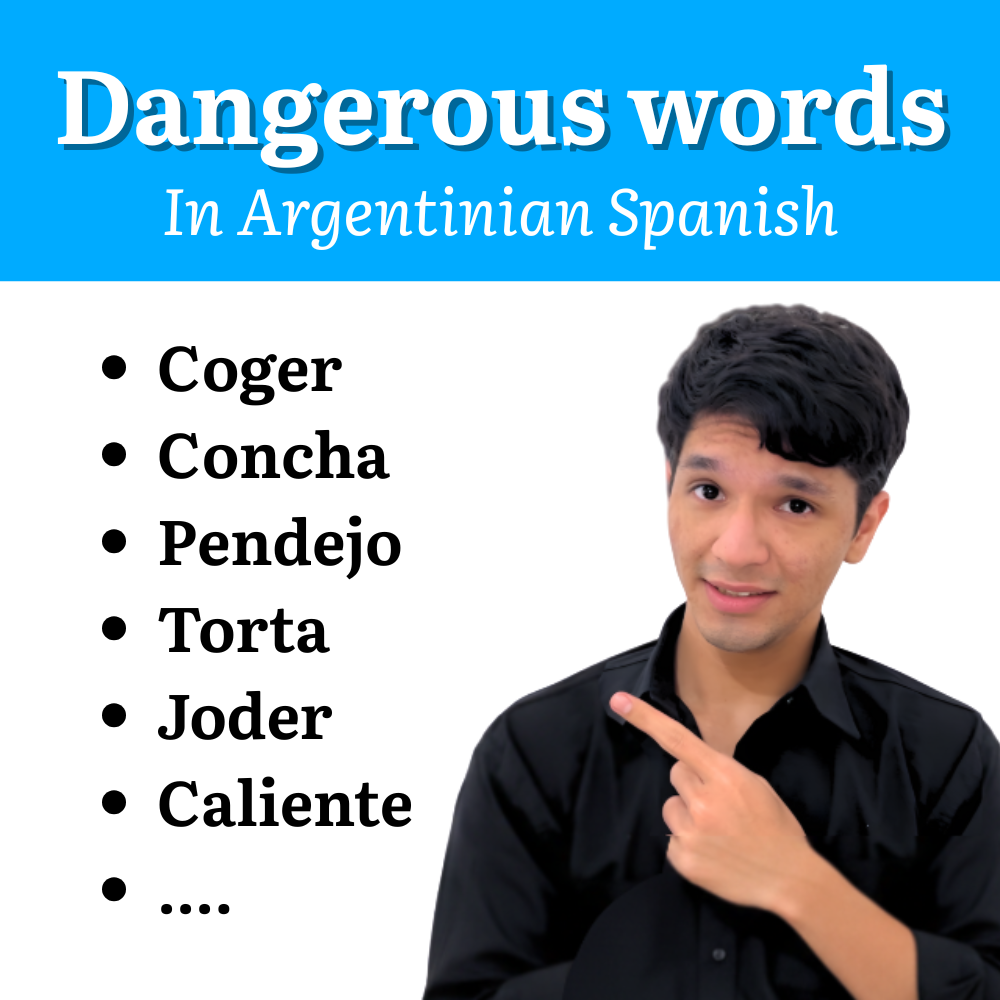
If you learned Spanish in Spain, Mexico, or at school… you might think you’re ready for a trip to Argentina.
Pero ojo, che (careful, mate).
In Argentina, we technically speak Spanish, yes—but in daily life many of us feel like we speak “Argentinian”: a version of Spanish with its own accent, rhythm, vocabulary, and a lot of slang called lunfardo.
So if you come here speaking “standard” Spanish and use some words you learned in Spain or Mexico, people might:
- Laugh
- Get confused
- Or even get offended 😬
In this article, I’ll show you real examples of words that are innocent in other countries but dangerous in Argentina. You’ll learn:
- What these words mean in Spain/Mexico
- What they mean in Argentina
- What to say instead
If you’re living in Buenos Aires, planning a trip to Argentina, working as a digital nomad in Argentina, retired in Argentina, or doing business in Argentina or if you just want to be fluent in this dialect, this is essential survival knowledge.
Why “Argentinian” Spanish Feels Like Another Language
Before we jump into the words, let’s understand why Spanish in Argentina feels so different.
Argentina, especially Buenos Aires, was shaped by massive immigration from Spain and Italy in the late 19th and early 20th centuries. That’s why:
- We use vos instead of tú
- We pronounce “ll” and “y” like “sh” or “zh” (yo → “sho”)
- We mix a lot of Italian intonation and local slang
The Spanish we speak around the Río de la Plata area (Buenos Aires, parts of Uruguay) is called:
- Español rioplatense – “Rioplatense Spanish”
- And the slang is lunfardo – the vocabulary that comes from Italian, old underworld slang, and everyday life
So yes, if you’re an expat in Argentina who learned Spanish in Spain, Mexico, Puerto Rico, or online with a generic teacher, you’ll probably understand the grammar… but you might completely misunderstand key words.
Let’s look at the most dangerous ones.
1. “Coger” – Totally Normal in Spain, Very Sexual in Argentina
In Spain and some other countries, coger is totally normal:
coger = to take, to grab, to pick up
- Voy a coger el teléfono. – “I’m going to pick up the phone.”
- ¿Puedo coger el bus aquí? – “Can I take the bus here?”
Sounds innocent, right?
What “coger” means in Argentina
In Argentina, coger is a vulgar way to say “to have sex.”
So if you come here and say:
- Voy a coger el colectivo.
Literally: “I’m going to take the bus.”
What Argentines hear: “I’m going to have sex with the bus.” 💀
People will laugh. A lot.
What to say instead
Use these verbs in Argentine Spanish:
- agarrar – to grab, to take
- Voy a agarrar el teléfono. – I’m going to pick up the phone.
- tomar – to take (transport, drinks)
- Voy a tomar el colectivo. – I’m going to take the bus.
- Voy a tomar un café. – I’m going to have a coffee.
If you’re a traveler in Argentina or a digital nomad in Buenos Aires, just delete “coger” from your active vocabulary while you’re here. Your life will be easier. 😉
2. “Concha” – A Shell… or Something Very Different
In generic Spanish, concha can mean “shell” (like a sea shell).
But in Argentina, concha is a vulgar word for female genitals.
So imagine this situation:
You’re at the beach in Mar del Plata, practising your Spanish, and you say:
- Mirá qué linda concha encontré en la playa.
You want to say: “Look at this nice shell I found on the beach.”
But you actually said something very graphic about anatomy.
What to say instead
If you want to talk about actual shells, use:
- caracola – seashell
- caparazón – shell (like a turtle)
Examples:
- Mirá qué linda caracola encontré. – Look at this beautiful shell I found.
Also, in Mexico, “concha” is a type of sweet bread. In Argentina, that bread doesn’t exist, and if you ask for una concha in a bakery, people will definitely react.
So if you’re living in Buenos Aires or visiting, keep concha on your internal list of “words I understand but never say.”
3. “Torta” – Cake… and Also a Lesbian (rude)
In most of Latin America, including Argentina:
torta = cake 🎂
Example:
- Quiero una torta de chocolate. – I want a chocolate cake.
So far, so good.
The problem with “torta” in Argentine slang
In Argentine slang, torta is also a rude word for a lesbian. It can be used jokingly between close friends in some groups, but for foreigners, it’s very easy to sound offensive.
So:
- Ella es torta. – She is a lesbian. (Rude/slang)
If you’re retired in Argentina or an expat building new friendships, be careful with this word in reference to people. Use more neutral and respectful language unless you really understand the context and relationship.
As food, no problem. As a label for a person, avoid it.
4. “Pendejo / Pendeja” – Mild in Mexico, Strong in Argentina
In Mexico, you’ll hear pendejo all the time. Depending on context, it can mean:
- Idiot / dumb
- A bit of an insult, but often used jokingly between friends
In Argentina, pendejo/pendeja is a strong insult for young people (specially teenagers).
Think: “little asshole”, “stupid kid”, or worse.
Example:
- No seas pendejo. – Don’t be such an idiot. (Very rude here)
Some people also use pendejo to mean “teenager” or “very young person” in a slightly negative way:
- Es un pendejo, no entiende nada. – He’s just a kid, he doesn’t understand anything.
Little exception
Among some young Argentines, you might hear “pendeja” used jokingly between friends, like:
- Che, pendeja, vení. – Hey, girl, come here.
But as a foreigner, expat, or traveler, my advice is simple:
Do not use pendejo/pendeja in Argentina.
Understand it, but don’t say it.
There are many safer words to say “kid”:
- chico/chica, nene/nena, pibe/piba (very Argentine, but not rude).


5. “Joder / Jodiendo / No me jodas” – Are You Kidding Me?
In Spain, joder is everywhere. It can mean:
- To annoy
- To screw up
- Or just an exclamation: ¡Joder! = Damn! / F*ck!
In Argentina, we do use joder, but mostly in two expressions:
- ¿Me estás jodiendo? – Are you kidding me? / Are you joking?
- No me jodas. – Don’t mess with me / Don’t bother me.
We also use the noun joda:
- joda = joke, or a party, depending on context
- ¿Es en serio o es una joda? – Are you serious or is it a joke?
- Vamos a una joda. – We’re going to a party.
Why it’s tricky for foreigners
These expressions can sound:
- Neutral/friendly between friends
- Or quite aggressive depending on tone and situation
For example:
- ¿Me estás jodiendo? with a smile → “Are you kidding me?”
- ¡No me jodas! shouted → “Don’t f*ck with me.”
If you’re doing business in Argentina, or meeting future partners, investors, or clients, I recommend:
Use more neutral alternatives unless you know people well.
For “Are you kidding?” you can say:
- ¿En serio? – Seriously?
- ¿De verdad? – Really?
For “Don’t bother me”:
- No me molestes. – Don’t bother me.
- No me rompas las pelotas. – Very Argentine, but also very vulgar. Don’t use this in professional settings.
6. “Estar caliente” – Hot, Angry, or Horny?
This one is classic Argentine Spanish confusion.
In English, “hot” can mean:
- Physically hot (temperature)
- Sexy / attractive
- Horny
In Argentine Spanish, estar caliente also has three meanings, depending on context:
- To be physically hot (temperature)
- Estoy caliente. – I’m hot (physically).
- To be angry
- Estoy caliente con Tomás. – I’m mad at Tomás.
- To be horny
- Estoy caliente. – I’m horny.
- Estoy caliente con Tomás. – I’m horny for Tomás.
Same sentence. Totally different meanings. 😅
How to avoid awkward moments
If you’re living in Buenos Aires and it’s summer, and you want to say “I’m hot”, a safer phrase is:
- Tengo calor. – I’m hot (temperature).
For “I’m angry with Tomás”, say:
- Estoy enojado/enojada con Tomás. – I’m angry with Tomás.
For “I’m horny”… well, you probably shouldn’t say that in Spanish class. 😏 But if you hear “estoy caliente” in a romantic context, you’ll know what it means.
7. “Mono / Monito” – Cute in Spain, Monkey in Argentina
In Spain, mono/monito is used all the time to mean:
mono = cute, adorable
Examples in Spain:
- ¡Qué mono el gato! – The cat is so cute.
- Tu hijo es monísimo. – Your son is really cute.
In Argentina, mono only means monkey.
So if you come here and say in Argentine Spanish:
- Tu hijo es muy mono.
People will most likely hear:
“Your son is very much a monkey.” 🐒
Not great.
What to say instead in Argentina
Use these words to say “cute”:
- lindo / linda – nice, cute, pretty
- tierno / tierna – tender, sweet
- dulce – sweet
Examples:
- ¡Qué lindo el gato! – What a cute cat.
- Tu hijo es re tierno. – Your son is really sweet.
If you’re an expat in Argentina and your Spanish teacher is from Spain, be especially careful with this one. It’s a small detail that totally changes how people perceive you.
8. “Cola” – Line… or Butt
Our last word is cola. In Argentina, it has two meanings:
- cola = butt / ass
- cola = line / queue
Examples:
- Me duele la cola. – My butt hurts.
- Había una cola larguísima en el banco. – There was a very long line at the bank.
This is one of those words that are technically “correct” but can sound funny or ambiguous without context.
If you just say:
- Había una cola… – “There was a butt…” or “There was a line…”
People will wait for the rest of the sentence to understand. Don’t stop halfway. 😄
You can also use:
- fila – line, queue
- Había una fila larguísima en el banco.
For everyday life in Buenos Aires—banks, supermarkets, government offices—you’ll hear cola a lot for “line”. Just be aware of the double meaning.
Why This Matters for Expats, Digital Nomads, and Business
Now you might think:
“Ok Nico, some words are rude, some are funny. Is it really that serious?”
Sí, bastante.
If you’re:
- Moving to Argentina
- If you want to be fluent in this dialect
- Retired in Argentina and building a new social circle
- A digital nomad in Argentina working remotely but dating locally
- Doing business in Argentina and meeting partners and clients
- Or simply planning several trips to Argentina over your life
Then your Spanish is not just “a school subject”. It’s a tool for relationships, opportunities, and daily survival.
Using one wrong word can mean:
- A joke that doesn’t land
- A first impression that feels rude or vulgar
- A potential client who thinks you’re unprofessional
- A friend or partner who feels disrespected
That’s why I always say:
It’s not enough to “speak Spanish.”
If your life is in Argentina, you need to Learn Spanish in Argentina – specifically Argentine Spanish.
How to Safely Learn Argentine Spanish (Without Fights or Embarrassing Moments)
All of this might feel a bit overwhelming, especially if you’ve studied Spanish for years and suddenly discover that half your vocabulary is dangerous in Buenos Aires.
But it’s actually good news.
It means that with a few focused lessons on Argentine Spanish and lunfardo, you can:
- Avoid the worst misunderstandings
- Sound more local and natural
- Connect faster with Argentines
- Feel safer in conversations, meetings, and dates
If you’re a beginner, a great starting point is reading simple, real Spanish in context. That’s exactly what we do in my 1:1 Programs to learn Argentine Spanish.
We work with real Argentine Spanish, real situations (banks, rentals, bureaucracy, friends, dates, work), and I guide you personally so you don’t accidentally say “coger el colectivo” in front of your future in-laws. 😅
Final Thoughts
Argentina is an amazing place to live, work, invest, or retire. The people are warm, funny, emotional, expressive. But to really enjoy your time here—and avoid unnecessary drama—you need to understand how we really speak.
So remember these key ideas:
- Argentine Spanish (español rioplatense) is different from Spain and Mexico.
- Words like coger, concha, torta, pendejo, joder, estar caliente, mono, cola can completely change meaning here.
- As an expat, traveler, or professional, using the wrong word can affect your relationships and opportunities.
Take this seriously—but also enjoy it. Learning Argentine Spanish is not just about grammar; it’s about connecting with a new culture for the rest of your life.
If you’re planning to travel to Argentina, live in Buenos Aires, or build your future here, start working on your Argentine Spanish today. Your future self (and your future friends, partners, and clients) will thank you.
Learn more with this video:
How I Can Help You Speak Argentinian Spanish
If you’re serious about traveling, moving to Argentina, or just finally learning the language that you’ve always wanted to speak — I’m here to help.
I’m Nicolas Gonzalez Miño, Argentine Spanish teacher, owner of the YouTube Channel “Spanish with Nico”, the founder of Spanish Mindset Academy – Learn Argentinian Spanish and the author of Mini Stories to Learn Spanish for Beginners, available on Amazon. Also, I have 2 podcast Argento Podcast, & Argentine Spanish from Scratch where I teach real Argentinian Spanish and slang.
In my YouTube Channel “Spanish with Nico”, with +1500 subscribers, I teach Spanish language and our dialect -Argentinian Spanish- and I explain everything about Argentinian history and culture.
In my 1:1 programs, you can learn Argentinian Spanish from scratch, for traveling / living / business & finally REACH FLUENCY in Argentine Spanish.
Start learning Argentinian Spanish right now and be free in ARGENTINA!
👉 Ready to start?
Check the links below to join the Spanish Mindset Program, get the book, or contact me directly on here.
Click here for more details for: 1:1 PROGRAM.
Click here for more details for: 1:1 PROGRAM.
Click here for more details for: 1:1 PROGRAM.
📌 Ready to Learn More?
👉 Argentine Spanish 1:1 Programs: https://spanish-mindset.com/solo-lessons/
📘 Argentine Spanish Full guide: Argentine Spanish: The Definitive Beginner’s Guide (1 hr )
💬 Join my Community: ARGENTINA | Spanish with Nico
📩 My YouTube Channel, Spanish with Nico.


